Words are the Atoms in a Quantum System

“For we know in part and we prophesy in part, but when the perfect comes, the partial will pass away.” – 1 Corinthians 13:9-10

Words do weird things. By itself, a single word can mean many different things. Only through unity in a phrase, sentence, paragraph, or essay do words become more meaningful and magical.

Quantum systems do weird things too. Atoms and subatomic particles behave in ways that surprise our intuition. Physicists and hobbyists work hard to add to our partial knowledge about the fundamental nature of reality, but we still have not “figured it all out,” and maybe we never will in this life.

Just because two things behave strangely does not mean they are the same. Still, both words and atoms act in ways that draw our attention to a deeper connection, and that connection should shape how we think and act in the world.

We already have plenty of empirical interpretations for quantum systems. Yet it still bugs me that we can usually only say where an atom probably is and how fast it is probably moving. These systems become clear and coherent only when we look backward, but are impossible to predict with certainty when we look forward. Even more mysteriously, entangled particles seem to “share” information in ways that look like they bypass our normal sense of physical limits: measure one in a certain state, and its partner instantly shows a corresponding state even across great distances.

In other words, a particle could do many things, but we do not know which until it is “locked in.” And the systems seem to follow rules that sit beyond our current understanding of the universe. Like the turkey that assumes the sun will rise every day right up until the axe falls, we tend to oversimplify and overlook the chaos and complexity happening within and around us.

Our moral sense also seems to emerge from these lower layers: from deep within our being, through biology, which itself comes from chemistry and physics. Thus, it is wise to act in the world in a way that is consistent with the deepest truths of the world. So how should the chaotic, probabilistic nature of reality affect our mindset?

Photo by Owais Khan on Unsplash

Remind yourself: you are not alone. Someone is watching and measuring your steps. That Someone loves you and wants the best for you. He gives you the opportunity to orient yourself in the world by acting and believing, moving from “probably” to “definitely.” What if God were the ever‑present authority who judges with justice and responds with both discipline and mercy based on your actions and your heart? That would help explain why good things often come to those who act with compassion, determination, and love, and why those who live out of nihilism, pain, and hatred cannot finally escape the weight of inner guilt.

Faith in God is faith in the Father who walks with us and works through us, whether we understand it or not.


The atom is not aware of how it interacts with other atoms in a system, nor how it exists as an abstract, buzzing probability cloud until it is suddenly “locked into place.” In a similar way, we only dimly see how our choices and relationships form a larger pattern until they are woven into a story.

Words also act like little atoms by themselves. They could mean many things at any given time, and they have connections among each other. Just look at that phrase: “Each other.”

“Other” often comes after “each,” but only when “each” is spoken first. The ideas carried by “each” or “other” could point in many directions by themselves. But when they are joined into “each other,” something new and beautiful appears: a greater meaning together that emerged beyond the individual meanings.

God’s Word as holy Scripture is itself a complex system of these little “atoms” or words that could have meant many things, but that were brought together and “locked into place” by the only One who can produce life through words. “For the Lord is a God of knowledge, and by him actions are weighed.” 1 Samuel 2-3. The Bible wrenches possibilities down into truth, turning probabilities into promises. It forms a deep consistency out of complexity, which is something we can only partially grasp, but should fully trust.

“For the word of God is living and active, sharper than any two-edged sword, piercing to the division of soul and of spirit, of joints and of marrow, and discerning the thoughts and intentions of the heart. And no creature is hidden from his sight, but all are naked and exposed to the eyes of him to whom we must give account.” – Hebrews 4:12-13

The day God reached me

joakim-honkasalo-ssvjJLB6wIw-unsplash
Photo by Joakim Honkasalo on Unsplash

In June, 2018, I had a supernatural experience.

For a few months before, I had begun to explore the Bible with fresh eyes. But up until that day, God and religion were still intellectual pursuits. That changed in one day.

As part of the service, hundreds in the massive auditorium started praying together: some silently, some aloud. We were sitting, packed to other in the middle of the room. A few people cried out to God, sobbing, reciting lines, asking for forgiveness, and thanking him for his grace. I held my Bible in my hands and closed my eyes. I focused on my prayer.

Then two things happened.

I perceived my Bible grow in width in between my hands. The book seemed to expand between my hands, even though separately my arms felt in the same location. The book was expanding right and left, like into a different dimension. It was filling the space with unimaginable depth. I felt the importance of these words.

Second, my mind began to grow distant from my surroundings. I was falling backwards from reality. I perceived myself slip further away. A great distance was opening between the edge of my senses to where I was. The chasm grew in depth and weight to a point to which I could not measure it. I began to lose touch with my senses and reality opened up to me within myself.

With my eyes closed, I saw a vision of a light blue wire connecting from the top of my spine upwards. It curved up hundreds of feet and forward into a great presence, a light, a cloud, something up there. I saw many other blue wires connecting to that top point from everyone else worshiping in the room.


In both cases, I felt warm and filled with purpose. I wasn’t afraid… not exactly. I was awe-struck; filled with wonder at these two parts of my experience. Eventually, I arose back into reality with a fresh respect for life.

These visions and experiences were as original as I can guess. It’s hard for me to explain where I may have gotten the “inspiration” or been “imprinted” by them. So, as much as I can tell, I had a legitimate, lucid, spiritual experience. In my own way, I was touched by God.

After that day, my spirituality shifted from an intellectual exercise to a fundamental life journey.

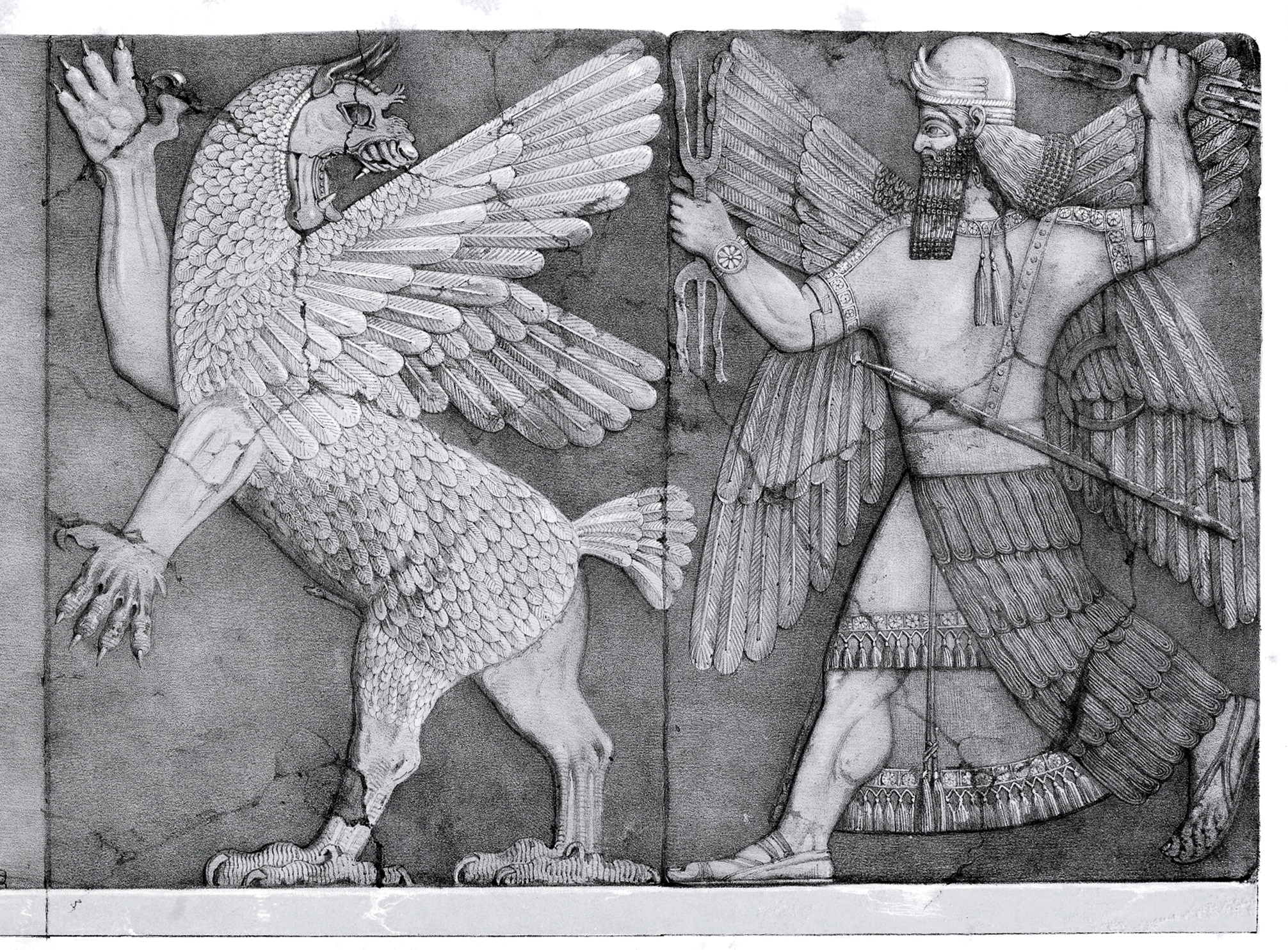
More names = more power – OGB #5 Babylonian Genesis by Alexander Heidel

https://upload.wikimedia.org/wikipedia/commons/c/c3/Chaos_Monster_and_Sun_God.png

Enuma Elish is a Babylonian creation story that outlines a god Marduk who destroys an evil dragon, saves the day, and earns dominion over all the other gods. To transcend the other gods, Marduk incorporates their names and powers into his own being. The only way to really capture the essence of Marduk is to say his 50+ names. These names and what they symbolize are literally the best things in the world.

To earn similar powers, we can embody Marduk in our daily life. We can go out and courageously fight evil. Find the dragon, slay it, earn the treasure, save the town, and then go do it again.

We can clearly see similarities between the following attributes and the attributes of the Christian God that came along after Babylon and Enuma Elish. This is a fascinating precursor to modern religions and world-views. The language we use today to describe the most powerful things has been around for centuries. This fact gives us a perspective of awe at our ancestors: they were more creative than we give them credit for. And we owe more respect to how their ideas have shaped our world.

(all quoted from “The Babylonian Genesis” by Alexander Heidel)

Come, let us proclaim [Marduk’s] fifty names! …

The provider of pasture land and drinking places, who fills their stalls with plenty;

Who with his weapon, the rain flood, overcame the enemies;

Who saved the gods his fathers in distress…

At his command let there be creation, destruction, alleviation, mercy

(Heidel)

Then all of Marduk’s other names are now listed with their specialties: some are below. These names and what they symbolize are the most powerful things in the world. I bolded similarities between the names and the names of the modern Christian God.

Marrukka verily is the god, the creator of everything;

Namtillaku, the god who restores to life;

Namshub; the bright god who brightens our way.

Asaru, the bestower of arable land, the creator of grain and legumes,

Asaralimnunna, the mighty one,

Tutu, the author of their restoration;

No one among the gods can equal him.

Ziukinna, the life of the host of the gods;

Ziku, the maintainer of purification;

The god of the good breath (of life), the lord who hears and answers (prayer);

The creator of riches and plenty, the establisher of abundance;

Who has turned all our wants into plenty;

Agaku, the lord of the holy incantation, who restores to life the dead;

Who created mankind to set them free;

Shazu, who knows the hearts of the gods, who sees through the innermost parts;

From whom the evildoer cannot escape;

The administrator of justice, who puts an end to crooked speech;

Who in his place discerns falsehood and truth.

Epadun, the lord who waters the field;

The ruler of heaven (and) earth,

Gilma, the bond that holds the family together,

Agilma, the sublime,

Nibiru shall be in control of the passages in heaven and on earth,

May he shepherd all the gods like sheep.

Let (man) rejoice in Marduk,

Reliable is his word, unalterable his command;

The utterance of his mouth no god whatever can change.

(Heidel)

Marduk speaks with the power of creation and authority. Everything else comes from his ability to speak into being. This is a reminder that our own words have the power to create or destroy, so use them wisely!

Back to the beginning: Reality From Language – OGB #4 Genesis by Robert Alter

Reality is how we talk about it. In times of chaos and change, it’s helpful to backtrack to some fundamental order and start over. Genesis (translated by Robert Alter 039331670X) is one example we can read to remind ourselves what’s real.

Bottom Line Up Front

What if reality is a chaos soup: cells and atoms bouncing around. Humans evolved to survive and thrive in the chaos soup over many lifespans. To do this, the collective consciousness of humanity started to recognize patterns in the chaos. They did this by bootstrapping a biological tool: language.

This tool gave the emergent human collective brain a way to set order from the chaos. Humans recognized the cells and atoms consistently bouncing around into a drinkable source of water. We named “stream” as a “drinkable source of water.” This shared understanding gave power to each individual within the collective to navigate the world using “streams” for drinking water and finding fish. This ability is so powerful and so unlikely that it seems God-given. Genesis explains the origin of reality as the use of language. Furthermore, the text relies on the same tool to communicate itself down through generations of humans.

Example

In Genesis, God speaks reality. In the first six days, God creates things. The biblical text follows a structure of God “saying” things, then God saying the words, which results in: “so it was.” Creation comes from speaking into being.

“And God said, “Let the waters under the heavens be gathered in one place so that the dry land will appear,” and so it was.” (Alter, 4)

Since the steps of “saying” and “so it was” are separated by an “and,” it’s not clear whether God does two actions or one. It seems as though the speaking suffices without any other action. Speaking is the magic here: by invoking language to call a pattern of chaotic soup into a name which can then interact with other named things. Humans can then navigate this system of named representations much better than the chaos soup.

Every word has meaning and contributes to reality. How we use language builds our world. Being honest and speaking truth builds a more durable reality.

Was language the reason why reality exists as it does to us today? Could God use any other tool to create this reality other than language?

Praying intentionally as a way to gain patience, oneness, and optimism

billy-pasco-se3tHNszbkM-unsplash

Photo by Billy Pasco on Unsplash

In April 2018, I began to pray. I had never really tried that hard to pray before. I had learned to pray before meals and pray before bed. Both of which are important. But the words I was reciting felt empty and meaningless. Inspired by Pastor David Platt and my renewed interest in spirituality, I began praying more intentionally. I tried a different approach.

I started to speak from my heart with meaning. I did not ask for things I want, rather I asked for guidance. And before asking for anything, I submitted myself to gratitude. I said, “Thank you, God. I am so grateful for the blessings you’ve given me. I don’t deserve any of this, and yet you’ve chosen me.” When I pray, I hear an echo in reply. I don’t know from where the echo responds. But the voice guides me when I submit my weakness and ask for help. It gives me answers and hard truths.

God is many things to many people. I changed from asking for things I don’t have, to thankfulness for what I already have. This is because I realized who I was talking to: God. Jordan Peterson put it best in his conversation with Sam Harris. I understand the gravity and magnificence of God in these terms:

God is how we imaginatively and collectively represent the existence of an action of consciousness across time; as the most real aspects of existence manifest themselves across the longest of time-frames but are not necessarily apprehensible as objects in the here and now…

So God is that which eternally dies and is reborn in the pursuit of higher being and truth. That’s a fundamental element of the hero mythology.

God is the highest value in the hierarchy of values; that’s another way of looking at it.

God is what calls and what responds in the eternal call to adventure.

God is the voice of conscience.

God is the source of judgment, mercy, and guilt.

God is the future to which we make sacrifices and something akin to the transcendental repository of reputation.

Here’s a cool one if you’re an evolutionary biologist. God is that which selects among men in the eternal hierarchy of men.

-Jordan Peterson, https://youtu.be/jey_CzIOfYE

Since I’m still early on in my spiritual journey, I am interested in my own relationship with God through prayer. I’m not interested in telling everyone else what to do. In my personal experience, my prayer resulted in newfound patience, self-integration, and optimism.

I became more patient because I stopped asking for things that I wasn’t getting. Instead, I asked for guidance and strength in the face of difficulty. And even then, I knew that the world could crash down on my family and me in an instant. Through it all, I would get what I need, not what I want. This meant that I learned patience. Usually, I demanded results and progress. But I soon discovered that I often don’t know what’s best for me. And I receive what’s best slowly.

I became more self-integrated. As I spoke from my heart, I said whatever came naturally. That is genuinely what we care about – not what we want ourselves to care about. I began to notice the things that bubble up to my thoughts, but I don’t flesh out. Maybe because I’m embarrassed about them. Instead, I give them to God through prayer. And when I put them into words, God accepts them and replies with an answer. In this way, I accept myself as speaking these words, because God accepts me. I could say what I think is the worst thing, but if God responds and accepts me regardless, then I can own this part of me without ignoring or suppressing it. In this way, I can integrate the not-so-good parts of me and control them, instead of suppressing them and risking that they overcome me.

Lastly, I have a newfound optimism. So far, I’ve shared the deepest thoughts of my heart to God, and he still calls me forward. In this way, I know that there’s nothing that I can do that will separate us. Of course, I’ll make mistakes as I search for the best path toward the good life. Calamity will happen and test or break my will. But I can rest assured that I will not be alone through the adventure.

I should pray about the things that I don’t understand because I need help in those areas. If I pray the same way every time, and I ask questions that I know the answer to, I don’t gain anything. By digging deep and intentionally building a relationship to God through prayer, I have more patience, self-integration, and optimism.