The Leviathan Cycle and its forerunners

Foreword:

AI did not write this post. I wrote it. However, AI did create some cool art as accompaniments.

Remember: the whole point is about the host, not the guest.

Grant – June 9, 2026.

1. Devastation

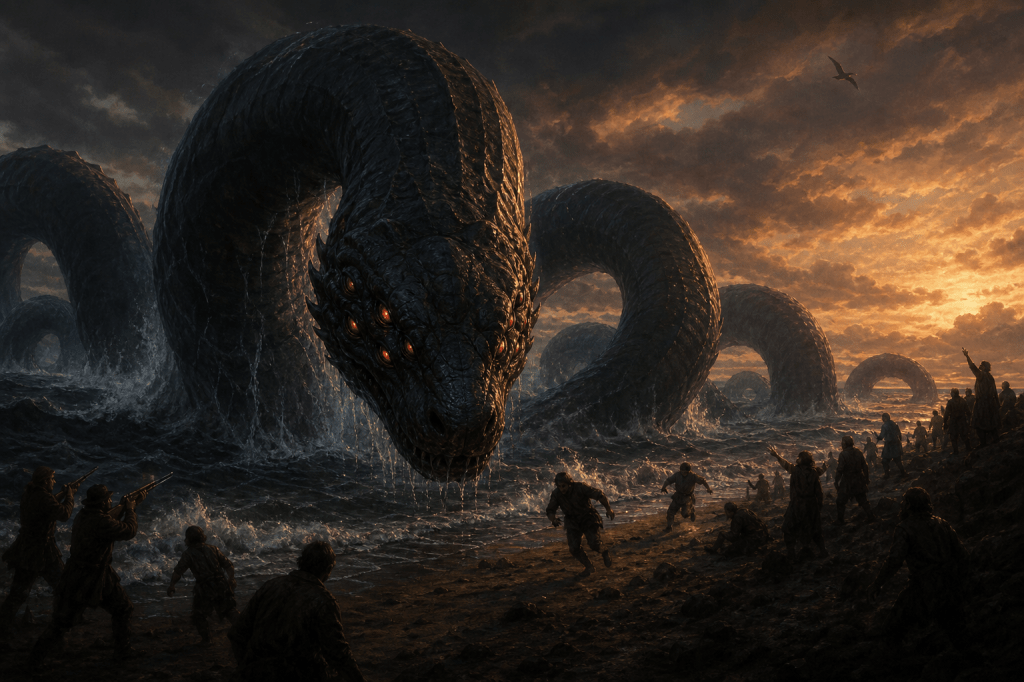
The Leviathan coils itself, sucking in the salty air. At last. Curling, its dark body pulses and sways. Red eyes pierce the men on shore. Some run. Some freeze, staring. Some welcome it, finally seeing the end as near, and the start. Some train guns upon it. But there are too many bodies; the mass is too large; it’s a futile task. Air hangs thick. A gull caws and flies away, sensing the doom. We have invited the snake into our home, seeing it as our savior. It was never our savior. The snake devours. It does not forgive. The Leviathan inhales, smelling weakness.

Suddenly, the Leviathan twitches and lunges, crashing onto shore. Immediately blood, bodies, crunched and squeezed until bursting. Cracking bones and peeling flesh. Civility is lost. We have invited the snake into our minds. It eats us.

What fills the place of a culture, negated? The Leviathan is not an invader. It is a guest, and it landed when we stopped believing in ourselves. Mercy, as surrender. When the walls were torn down from within, this was always to be the inevitable end.

2. Desperation

But this drama has occurred many times before. Victory is all but guaranteed if we believe in the only one who can defeat the Leviathan.

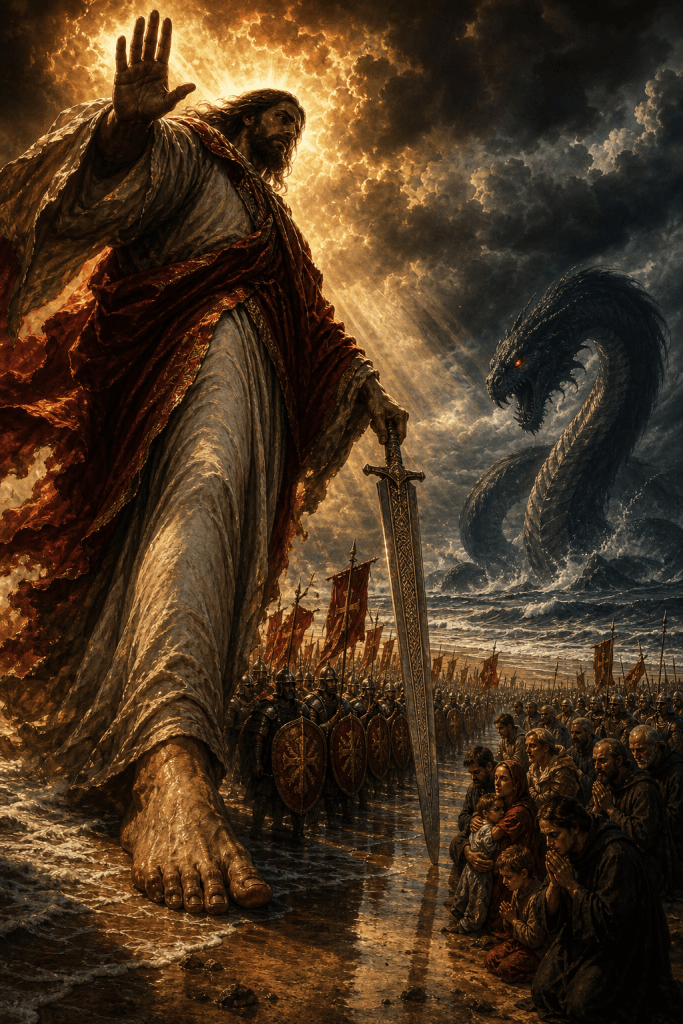
Who is Jesus? Order, with a sword. Red covers pure, holy white. Is it wine, or blood? The snake recoils, smaller now. Families and armies pray.

Hold the line! Light pierces darkness. See how the foamy seas have parted. This path will not be flooded.

The savior commands the boundaries to hold. Hierarchy is the last bastion and

WE WILL NOT YIELD.

Jesus excludes. How can it be? He discriminates against evil, to love and shape his sheep. There is no pity for the filthy snake here. “Didn’t we know he was a snake when we invited him?”

3. Resolution.

Oh, the horror!

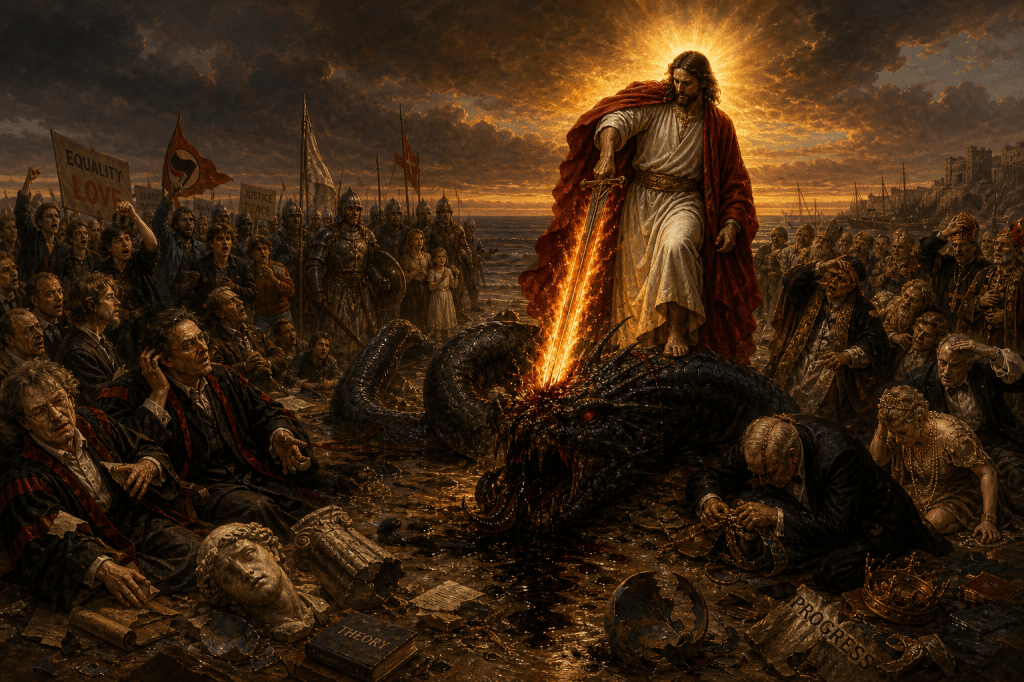
The beautiful, gory, physical, and metaphorical climax has already been foretold. The Leviathan must die if it arrives to the shore. We alone cannot kill it though, nor would we even if we could. But see the surprised faces. They reveal those who welcomes the serpent: The Saints, the outcasts, me, you…

I do not see the celebrations. The strong have become weak, because their worldview has crumbled.

Professors stare in disbelief. The theory built on induction does not predict the black swan, nor the man in red and white. This wasn’t the plan.

Activists continue shouting in anger. Rage, at what exactly?

The frauds twisting religion. They recoil, as if seeing evil. “This cannot be the Christ! It’s not the one that we fed to the masses.”

The plans of the poor, wealthy, powerful, and weak: all shattered. We placed our hope in that which promised a world of our own making. We sacrificed our faith for a lie: in an Enlightenment universal acceptance that we have no right to give. We forgot that we need to play our part, and we are not the character who decides fate. So, our false devotion is pierced by the sword of truth.

People who make “guilt” their first principle will not survive contact with that which has not.

But there’s a hope. A young girl claps in awe. The rest of us thought that the Leviathan was our savior. But she knows that Jesus is a man, who is in heaven.

4. Revelation

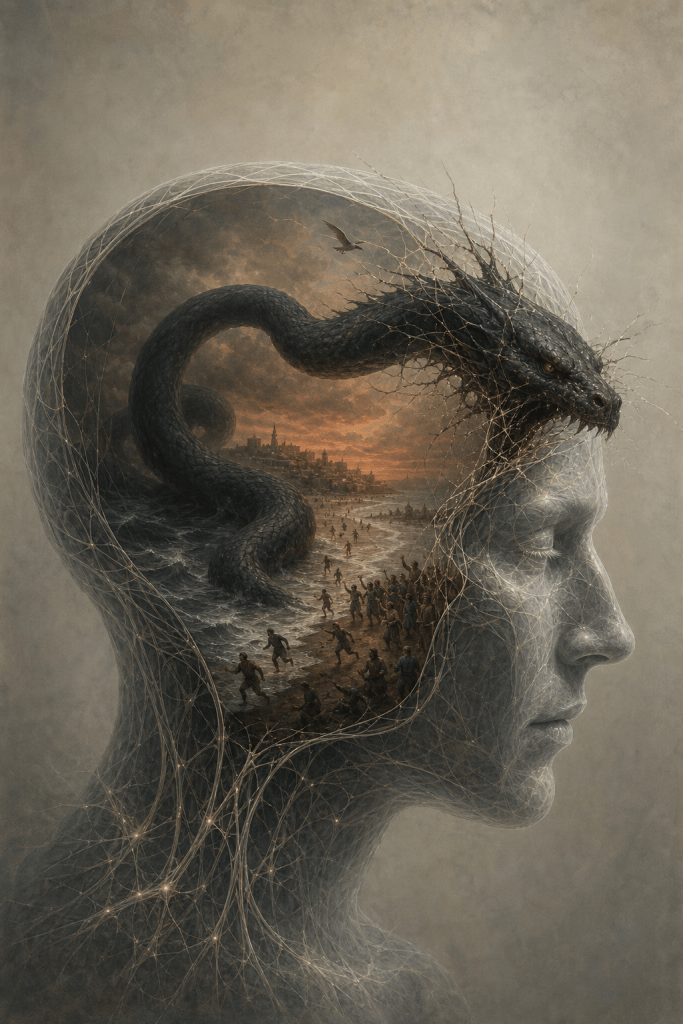
Leviathan arrives, Christ defends, Christ attacks, Leviathan dies. This is the drama playing out in every human heart and mind. Even today, the snake slithers around until it finds the weakest point. Right now, have given up the belief in ourselves. We have negated our identity, our stories, and our collective self-assurance. We have invited a universality of “average” to tear down the “great.” We cannot continue to internalize contradictions.

“I hate myself. Why should I continue to exist?” This is the snake.

Cull your Leviathan before it eats us.


Images generated by Perplexity AI

Words are the Atoms in a Quantum System

“For we know in part and we prophesy in part, but when the perfect comes, the partial will pass away.” – 1 Corinthians 13:9-10

Words do weird things. By itself, a single word can mean many different things. Only through unity in a phrase, sentence, paragraph, or essay do words become more meaningful and magical.

Quantum systems do weird things too. Atoms and subatomic particles behave in ways that surprise our intuition. Physicists and hobbyists work hard to add to our partial knowledge about the fundamental nature of reality, but we still have not “figured it all out,” and maybe we never will in this life.

Just because two things behave strangely does not mean they are the same. Still, both words and atoms act in ways that draw our attention to a deeper connection, and that connection should shape how we think and act in the world.

We already have plenty of empirical interpretations for quantum systems. Yet it still bugs me that we can usually only say where an atom probably is and how fast it is probably moving. These systems become clear and coherent only when we look backward, but are impossible to predict with certainty when we look forward. Even more mysteriously, entangled particles seem to “share” information in ways that look like they bypass our normal sense of physical limits: measure one in a certain state, and its partner instantly shows a corresponding state even across great distances.

In other words, a particle could do many things, but we do not know which until it is “locked in.” And the systems seem to follow rules that sit beyond our current understanding of the universe. Like the turkey that assumes the sun will rise every day right up until the axe falls, we tend to oversimplify and overlook the chaos and complexity happening within and around us.

Our moral sense also seems to emerge from these lower layers: from deep within our being, through biology, which itself comes from chemistry and physics. Thus, it is wise to act in the world in a way that is consistent with the deepest truths of the world. So how should the chaotic, probabilistic nature of reality affect our mindset?

Photo by Owais Khan on Unsplash

Remind yourself: you are not alone. Someone is watching and measuring your steps. That Someone loves you and wants the best for you. He gives you the opportunity to orient yourself in the world by acting and believing, moving from “probably” to “definitely.” What if God were the ever‑present authority who judges with justice and responds with both discipline and mercy based on your actions and your heart? That would help explain why good things often come to those who act with compassion, determination, and love, and why those who live out of nihilism, pain, and hatred cannot finally escape the weight of inner guilt.

Faith in God is faith in the Father who walks with us and works through us, whether we understand it or not.


The atom is not aware of how it interacts with other atoms in a system, nor how it exists as an abstract, buzzing probability cloud until it is suddenly “locked into place.” In a similar way, we only dimly see how our choices and relationships form a larger pattern until they are woven into a story.

Words also act like little atoms by themselves. They could mean many things at any given time, and they have connections among each other. Just look at that phrase: “Each other.”

“Other” often comes after “each,” but only when “each” is spoken first. The ideas carried by “each” or “other” could point in many directions by themselves. But when they are joined into “each other,” something new and beautiful appears: a greater meaning together that emerged beyond the individual meanings.

God’s Word as holy Scripture is itself a complex system of these little “atoms” or words that could have meant many things, but that were brought together and “locked into place” by the only One who can produce life through words. “For the Lord is a God of knowledge, and by him actions are weighed.” 1 Samuel 2-3. The Bible wrenches possibilities down into truth, turning probabilities into promises. It forms a deep consistency out of complexity, which is something we can only partially grasp, but should fully trust.

“For the word of God is living and active, sharper than any two-edged sword, piercing to the division of soul and of spirit, of joints and of marrow, and discerning the thoughts and intentions of the heart. And no creature is hidden from his sight, but all are naked and exposed to the eyes of him to whom we must give account.” – Hebrews 4:12-13