Foreword:
AI did not write this post. I wrote it. However, AI did create some cool art as accompaniments.
Remember: the whole point is about the host, not the guest.
Grant – June 9, 2026.
1. Devastation
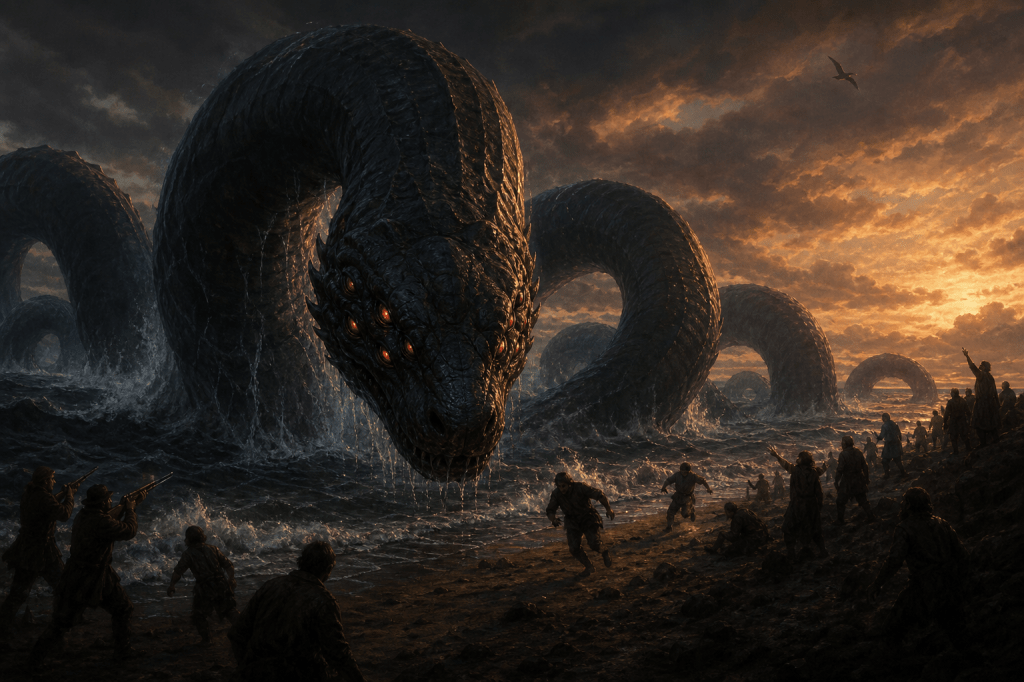
The Leviathan coils itself, sucking in the salty air. At last. Curling, its dark body pulses and sways. Red eyes pierce the men on shore. Some run. Some freeze, staring. Some welcome it, finally seeing the end as near, and the start. Some train guns upon it. But there are too many bodies; the mass is too large; it’s a futile task. Air hangs thick. A gull caws and flies away, sensing the doom. We have invited the snake into our home, seeing it as our savior. It was never our savior. The snake devours. It does not forgive. The Leviathan inhales, smelling weakness.
Suddenly, the Leviathan twitches and lunges, crashing onto shore. Immediately blood, bodies, crunched and squeezed until bursting. Cracking bones and peeling flesh. Civility is lost. We have invited the snake into our minds. It eats us.
What fills the place of a culture, negated? The Leviathan is not an invader. It is a guest, and it landed when we stopped believing in ourselves. Mercy, as surrender. When the walls were torn down from within, this was always to be the inevitable end.
2. Desperation
But this drama has occurred many times before. Victory is all but guaranteed if we believe in the only one who can defeat the Leviathan.
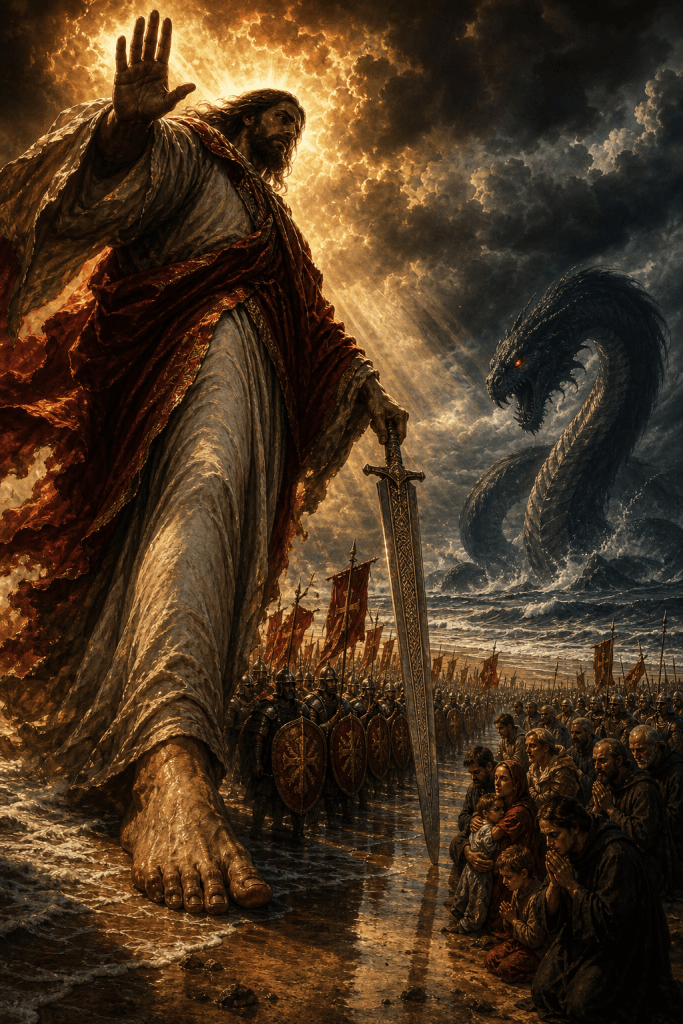
Who is Jesus? Order, with a sword. Red covers pure, holy white. Is it wine, or blood? The snake recoils, smaller now. Families and armies pray.
Hold the line! Light pierces darkness. See how the foamy seas have parted. This path will not be flooded.
The savior commands the boundaries to hold. Hierarchy is the last bastion and
WE WILL NOT YIELD.
Jesus excludes. How can it be? He discriminates against evil, to love and shape his sheep. There is no pity for the filthy snake here. “Didn’t we know he was a snake when we invited him?”
3. Resolution.
Oh, the horror!
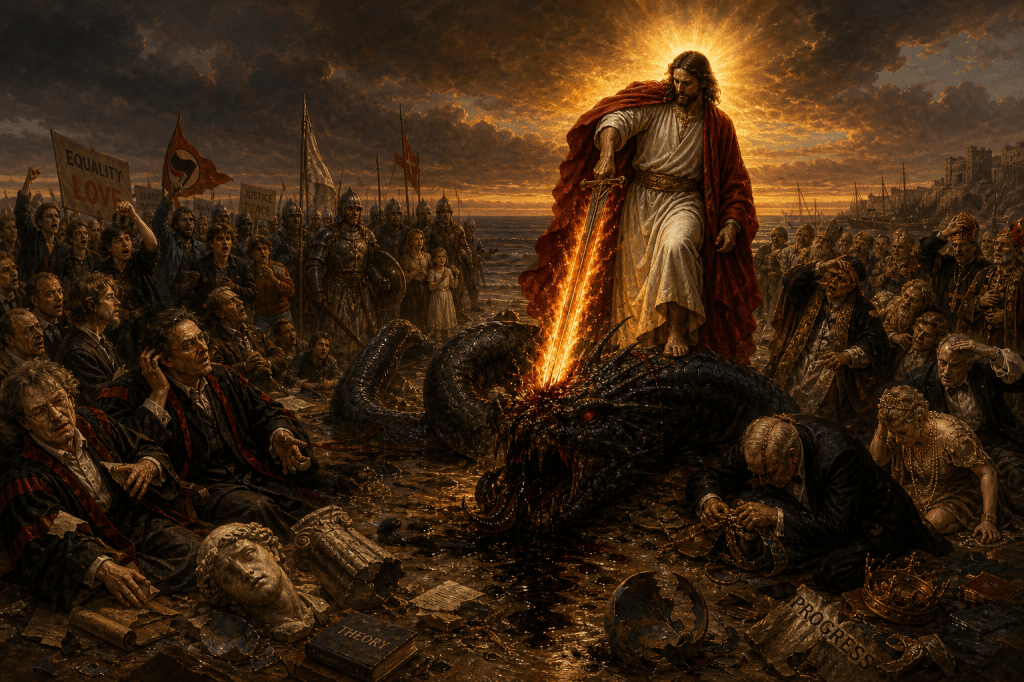
The beautiful, gory, physical, and metaphorical climax has already been foretold. The Leviathan must die if it arrives to the shore. We alone cannot kill it though, nor would we even if we could. But see the surprised faces. They reveal those who welcomes the serpent: The Saints, the outcasts, me, you…
I do not see the celebrations. The strong have become weak, because their worldview has crumbled.
Professors stare in disbelief. The theory built on induction does not predict the black swan, nor the man in red and white. This wasn’t the plan.
Activists continue shouting in anger. Rage, at what exactly?
The frauds twisting religion. They recoil, as if seeing evil. “This cannot be the Christ! It’s not the one that we fed to the masses.”
The plans of the poor, wealthy, powerful, and weak: all shattered. We placed our hope in that which promised a world of our own making. We sacrificed our faith for a lie: in an Enlightenment universal acceptance that we have no right to give. We forgot that we need to play our part, and we are not the character who decides fate. So, our false devotion is pierced by the sword of truth.
People who make “guilt” their first principle will not survive contact with that which has not.
But there’s a hope. A young girl claps in awe. The rest of us thought that the Leviathan was our savior. But she knows that Jesus is a man, who is in heaven.
4. Revelation
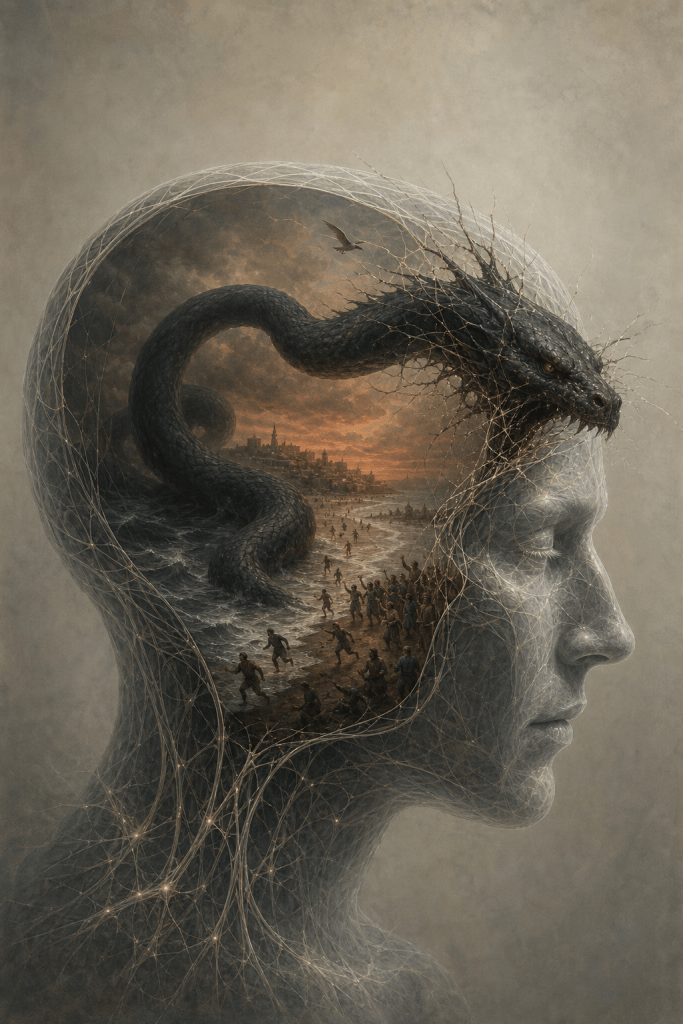
Leviathan arrives, Christ defends, Christ attacks, Leviathan dies. This is the drama playing out in every human heart and mind. Even today, the snake slithers around until it finds the weakest point. Right now, have given up the belief in ourselves. We have negated our identity, our stories, and our collective self-assurance. We have invited a universality of “average” to tear down the “great.” We cannot continue to internalize contradictions.
“I hate myself. Why should I continue to exist?” This is the snake.
Cull your Leviathan before it eats us.
Images generated by Perplexity AI



