Turn around, go past the train tracks, and keep going

I was out on a run on some country roads. As I took in the warm sun and raw landscape—grass, dirt, gravel, mud, and cows—I heard a voice calling out. I looked up. A woman had opened her window and was calling out to me with a distressed look. After a moment of confusion, I asked her what she said.

Made with DALL·E

She asked where US Cold Storage was. I inched toward her car window. Sorry, I didn’t know. “Can you help me?” So, I checked on my phone and found it – she had been heading the wrong direction. There is limited phone service out there, so her phone wasn’t connecting. She tapped the screen pointlessly. So we spent a minute figuring it out together. I ended up explaining: “Turn around, go past the train tracks, and keep going. You’ll reach some light industry buildings. It’s on the right. If you reach the school, you’ve gone too far. If you get lost, stop by those industry buildings and ask someone there. I’m sure they’ll help you.” She thanked me profusely. She was here for work. She lived five hours away, and she was hoping to get a new job at this exact company. You could hear the weight of that drive in her voice. She pointed to her passenger seat: a neon jacket. Someone on her job site had left it, and now she could return it. I laughed and agreed: “Here’s this, and here’s my resume!”

Some car came up behind us, and I waved them past. They smiled and waved back. I gave them the thumbs up. Then I stepped back from the car. She wheeled around her faded blue Prius, slapping mud and gravel into the air. Then she drove off. That was it.

I don’t know what it was about this experience, but something resonated with me about experience of life in simplicity. No service. Giving directions with landmarks. Helping a stranger. There was something literary about the whole thing—like a fleeting roadside encounter out of Kerouac. I realized that life is still simple in these unimpressive moments.

Confronting Lack of Purpose through Small Consistent Improvements

Purpose often feels elusive in modern life. It’s easy to drift through existence, haunted by a sense of emptiness that no amount of success, pleasure, or material gain seems to fill. This spiritual gap has become a defining characteristic of our age. But what is the nature of this gap, and how can we address it?

Zima Blue: The Search for Meaning in Simplicity
The animated short “Zima Blue” from Love, Death & Robots presents a narrative that challenges our understanding of purpose and meaning. Zima, an artist who achieves cosmic fame, ultimately abandons his grand creations for the simple act of cleaning a pool. This shift speaks to a profound truth: sometimes, the fulfillment we seek lies not in the grand or the complex, but in the return to simplicity in performing simple tasks.

Zima’s journey is a stripping away of the unnecessary, a return to the essence of being. In a world obsessed with optimization and algorithms, his choice to find meaning in the simplest of acts serves as a powerful reminder that perhaps, in our pursuit of purpose, we’ve overcomplicated things. His story suggests that by reconnecting with the basic, often overlooked aspects of life, we might rediscover a sense of purpose that is authentic and fulfilling.

Surplus Enjoyment: The Journey of Modernity
Slavoj Žižek’s concept of “surplus enjoyment” offers a complementary perspective on the paradox of modern life. This concept refers to the excess pleasure derived not from satisfying desires but from the endless pursuit of them. Surplus enjoyment isn’t just about the pleasure we seek—it’s the insatiable drive that keeps us perpetually wanting more, never fully content. In some ways, this relentless pursuit can become a purpose in itself, though Žižek critiques this approach for its lack of substance.

But still, this idea resonates with the experiences of many who, despite achieving what society deems as success, still feel a lingering emptiness. The more we achieve, the more we realize that no external accomplishment can fill the internal void. This insight urges us to look beneath the surface of our desires and consider whether the journey itself is the ultimate goal.

This also echoes the advice of many self-help influencers on social media today, who advocate for “trusting the process” and embracing the “grind.” Their perspective, while not new, has found renewed relevance in a modern age that seeks purpose in constant self-improvement.

Filling the Spiritual Gap: A Personal Journey Toward Meaning
Reflecting on these ideas, I’ve come to see that the spiritual gap I perceive in myself mirrors the one I see in the world around me. Like many others, I’ve lived with a nagging sense of purposelessness. But instead of succumbing to it, I’ve chosen to confront it directly.

Purpose, I’ve learned, can be found in moving toward any positive direction while embracing the journey itself. I engage in this journey by focusing on small, consistent improvements in my sleep, attitude, prayer, diet, and exercise. Each week, I achieve a marginal gain, and then I repeat the process.

Like Zima, the pool I clean once will need to be cleaned again. I’ve found that the act of cleaning—the simple, repetitive tasks—can be a source of fulfillment in itself. So I, like Zima, clean the pool with enjoyment.

Bad things are good – Seneca – OGB #8

“Why do many difficult situations happen to good [people]?” (Seneca: Selected Dialogues and Consolations by Peter J. Anderson, page 2)

In On Providence, Seneca raises questions about hard things and answers with examples. Hard things apparently aren’t difficult: you’re just thinking about them wrong. These things are actually tests of endurance. Furthermore, these are actually necessary to become good and virtuous. Those who rise into the highest level of virtue become role models for others.

“A person can’t be a great role model without enduring misfortune.” (Anderson, 6)

Book knowledge does not produce virtue. One must perform actions of endurance through tough circumstances to gain virtue.

Seneca provides examples of role models who acted with virtue and endurance in the face of bad fortune. In fact, Fortune “used fire against Mucius, poverty against Fabricius, exile against Rutilius, torture against Regulus, poison against Socrates, and death against Cato.” (Anderson, 6). But all these people gained virtue through these tests.

According to Seneca, endurance tests are best when they are physical, rather than purely intellectual. Virtue comes through the pain of fire and torture, and the hunger from poverty and exile. But why? We could examine Seneca’s example of Socrates to discover more.

Credit: link

Socrates is known for his dialectic and rhetoric expertise. We imagine Socrates taking action by conversing with others, pressing them to examine their assumptions, and driving for truth. But Seneca highlights virtue through Socrates willingly drinking poison to uphold his beliefs after being convicted of treason. Socrates had the option to concede his beliefs, stay alive, and go into exile instead of drinking the poison. But, Socrates chose to uphold his beliefs and drink the poison. So, this physical act killed him. But instead of pitying Socrates for his misfortune and bad treatment, “we ought to envy him” because he endured the ultimate test of death, “happy and willing.” (Anderson, 6).

And maybe that’s the point: death. The best kind of endurance tests have a risk or guarantee of death.

It’s important to note that killing or hurting oneself for that sake alone is not virtuous. Pain for the sake of pain itself is not useful. Rather, fighting for something and facing a physical test with risk of death will produce growth along the path to virtue.

Boxers go through pain to break their bones so that the bones will grow back stronger. Hikers ascend higher and higher summits to maximize their potential and represent the best of humanity. The wounded soldier receives the highest military honor because they faced hardship. Socrates willingly drank the poison to show that “truth without life” is better than “life without truth.”

This reminds me of the Book of Job. Although this story is up to interpretation, one point is the inevitably of difficult things happening. We can react with rebellion or acceptance when tough tests happen. However, the best of us seek out these tests to grow into virtue. The question is: who is Job? Is he the force of rebellion or the force of acceptance in the face of difficulty?

Appreciating simplicity from afar at the Georgia O’Keeffe Museum

Wow, did Georgia O’Keeffe handle her color!

We visited the Georgia O’Keeffe Museum in Santa Fe, NM. I highly recommend seeing it. The Museum was comprehensive and detailed, showing us layers of O’Keeffe beyond her paintings. For that reason, I feel like I know her as Georgia.

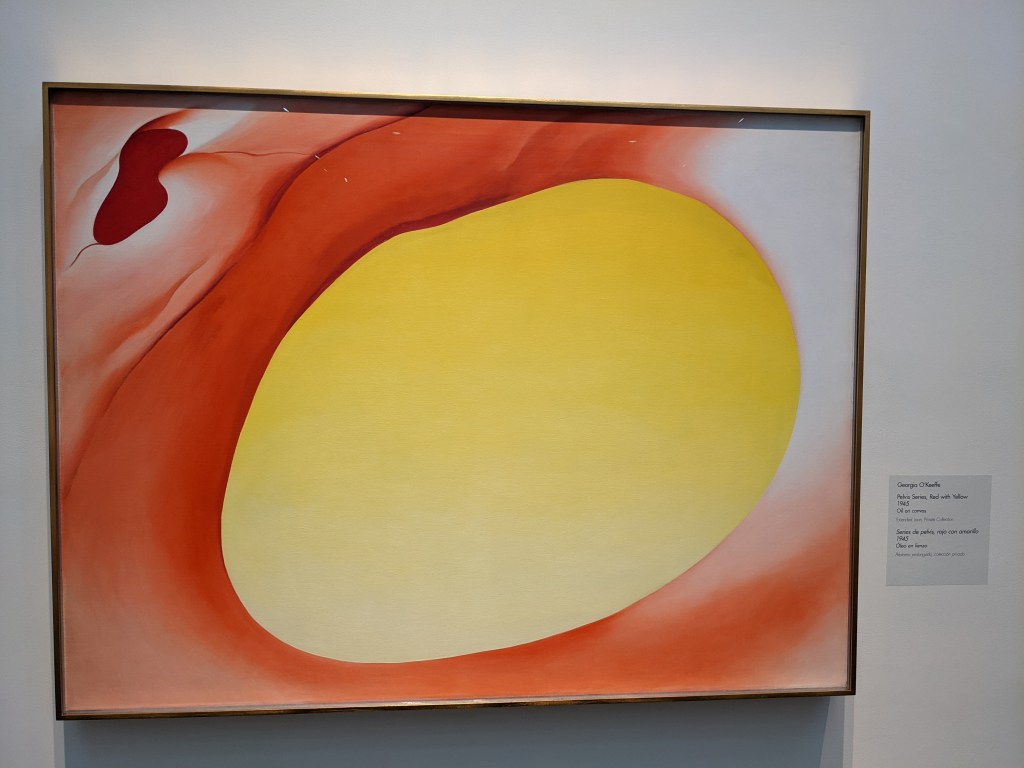
I was struck immediately by the nuance between Georgia’s gradients of color, attention to detail, and growth in artistic development over time. In the museum, we learned how Georgia began with formal art education in the early 1900s before breaking into abstraction. She attended to the small things, like the exact hues and shapes of simple objects like the center of a flower.

“Pelvis Series, Red with Yellow” by Georgia O’Keeffe (June, 2022)

She painted in New York City and met her partner there, but eventually left into nature at Lake George, New York. Then, she went further. She moved her life to beautiful, rural northern New Mexico. She had to experience the world at a slower pace – her own pace. Nature “speaks” to her.

As I gazed at the northern New Mexico landscapes, I was curious: how was Georgia a representation of pure American Modernism? She was capturing the wondrous landscape the local people saw every day. But, that’s the point: American Modernism, led by Georgia as its mother, aimed to show reality in an overly-industrialized era. Painting New Mexico flora, fauna, and daily life gave modern people a glimpse into a different reality outside the confines of busy Times Square or the four walls of a factory.

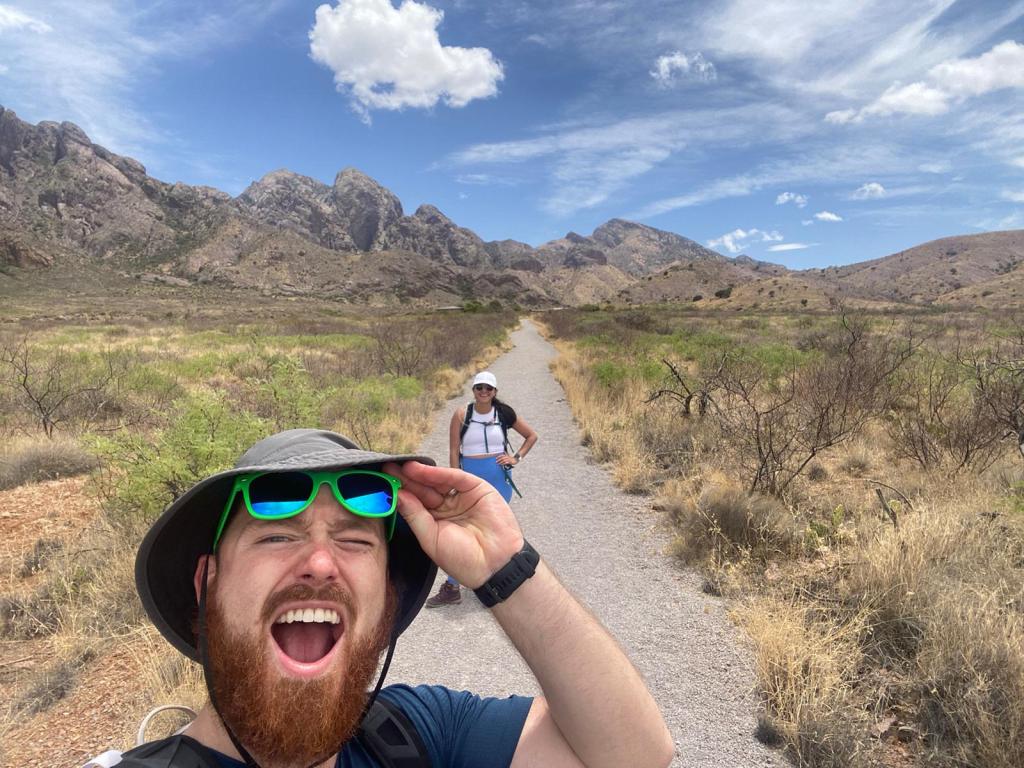
Natural beauty, and also Grant and Sahyli at Organ Mountains (June, 2022)

The previous week, we had driven south to Alamogordo and the White Sands National Park. During that three hour drive, we saw so many images Georgia could have painted. Natural beauty is commonplace here. We can thank Georgia for sharing it with the American people when we needed it most.

But she did more than share it: she connected our intimate, familiar relationship with nature to the divine – going beyond what exists toward what’s possible. This is where Georgia’s art shines. She had been painting the bones of animals in a way that brought them to life. She later evolved into gazing through the holes of pelvis bones and painting what she saw on the other side. She painted divine color schemes and shapes through the lens of the simple, wild beauty in front of her. These paintings are beautiful. They remind us that even the daily sunlight can be divine when viewed through the lens of “slow,” “compassion,” and “appreciation.”

She captured what sunlight should be: appreciated. She captured the shape of what “blue” would be if it were a shape.

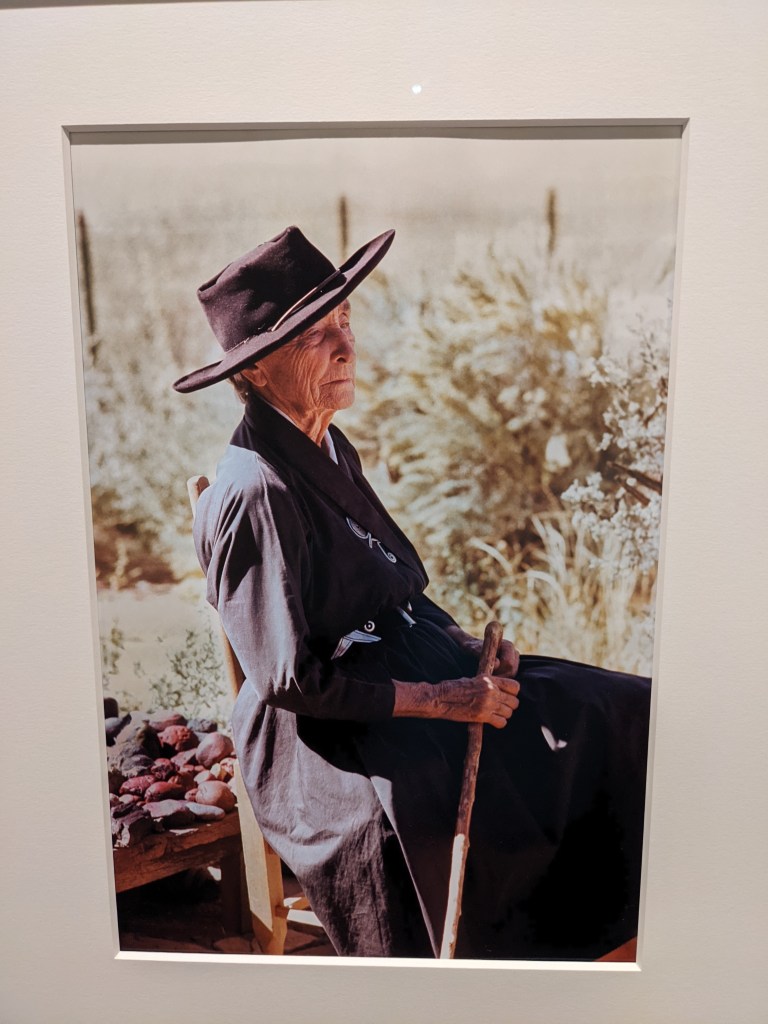
The world enjoyed 98 great years of Georgia before she passed away in her home in New Mexico.

“Blue II” by Georgia O’Keeffe, and also some guy (June, 2022)

It’s nice when the story has a nice ending that wraps up. But, that’s rarely the case. Art mimics life, and life mimics art. So, both moves on. The way to subvert American Modernism is to subvert Georgia O’Keeffe and her art. One way to do this would be to pretend to paint a landscape that isn’t a landscape. Or represent the shape of “blue” but paint it “red.”

I have to respect my contentious to subvert such a great artist as Georgia. Because although we need to appreciate her work, we need to see it as foundational but not the end. We can always extend, expand, condense, abstract, or even subvert the great works of our time. We must. Because that’s what Georgia did.

Georgia O’Keeffe photo looking like the badass she was (June, 2022)